Exercises for people who sit all day: a beginner routine
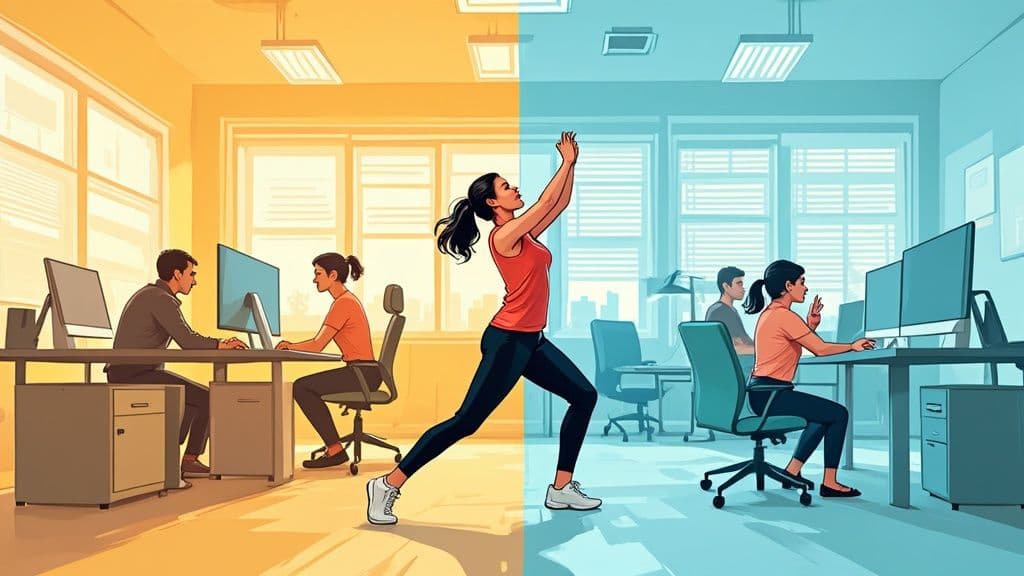
If you sit most of the day, you do not need a gym program first. You need a way to interrupt long sitting, then a short strength circuit you can progress. This page is that routine.
It is written for beginners who work at a desk. It is not a diagnosis, a rehab protocol, or a substitute for a clinician.
What this routine is trying to do
The WHO 2020 guidelines on physical activity and sedentary behaviour tell adults to do two jobs at once.
- Get enough weekly activity. For most adults that is at least 150 to 300 minutes of moderate aerobic activity, or 75 to 150 minutes of vigorous activity, plus muscle-strengthening on 2 or more days.
- Limit sitting. Replace some of it with movement of any intensity, including light movement. WHO did not set a single sitting-time cutoff. The instruction is still to sit less.
The American Heart Association says the same in shorter form. Get at least 150 minutes of moderate aerobic activity a week, add muscle-strengthening on at least 2 days, and spend less time sitting. Light activity still counts toward sitting less.
A gym session after work helps the first job. It does not finish the second if the rest of the day is uninterrupted sitting.
For the health-risks writeup, see sedentary lifestyle effects. This article stays on what to do.
Safety first. Stop a movement if you feel sharp pain, chest pain, unusual shortness of breath, dizziness, or faintness. Talk with a clinician before you raise intensity if you have known heart disease, uncontrolled blood pressure, a recent injury, or you are pregnant. This routine uses bodyweight and walking. It is not medical advice.
The 8-week beginner plan at a glance
Treat weeks as a ladder, not a test.
Weeks 1 to 2. Sit-break walks during work. Chair squats and wall push-ups after work, 2 days.
Weeks 3 to 4. Keep the sit-breaks. Add a third strength day. Swap wall push-ups for desk or knee push-ups if the wall version feels easy.
Weeks 5 to 8. Keep sit-breaks. Use the full after-work circuit below. Add one longer walk of 20 to 30 minutes on a non-strength day.
If a week feels like too much, repeat it. Progress is repeating the same work with slightly better control, then adding load.
Part 1. Interrupt sitting during the workday
A 2012 crossover trial in overweight adults found that 2 minutes of walking every 20 minutes lowered post-meal glucose and insulin compared with sitting the same stretch without breaks. That is Dunstan et al., Diabetes Care, n = 19, so treat it as mechanism evidence, not a universal prescription.
Use it as a timing template.
Cadence. Every 20 to 30 minutes, stand and walk for 2 minutes. Hallway, stairs, or a loop to the kettle all count.
If 20 minutes is unrealistic. Stand for 2 minutes at the end of each meeting, or walk during phone calls. Stairs instead of the elevator is a useful extra when you already have to change floors.
Desk circuit, about 3 minutes, when you cannot leave the chair for a walk. Do 1 round.
- Shoulder blade squeeze. Sit tall. Draw the shoulder blades toward each other without shrugging. Hold 5 seconds. Repeat 8 times.
- Neck side bend. Tilt one ear toward the shoulder. Hold 15 seconds each side. No yanking, no circles if they make you dizzy.
- Wrist flexor stretch. Elbow straight, palm up, other hand easing the fingers down. Hold 15 seconds each side.
- Seated leg extension. Straighten one knee, hold 3 seconds, lower. 8 each side.
- Calf raise. Stand behind the chair. Rise onto the balls of the feet, pause, lower. 10 to 12 reps.
Modifications. Skip neck side bends if they reproduce arm tingling or headache. Skip calf raises if you have acute Achilles pain. Do the squeezes and wrist stretch only.
Part 2. After-work beginner strength, 20 to 25 minutes
Do this on 2 days in weeks 1 to 2, then 3 days from week 3. Leave a rest day between hard sessions when you can.
Warm up with 3 minutes of easy walking, arm circles, and a few bodyweight sit-to-stands.
| Movement | Beginner | Standard | If that is too easy |
|---|---|---|---|
| Sit-to-stand / squat | Sit-to-stand from a chair, 2 sets of 8 | Chair squat, tap the seat, 3 sets of 10 to 12 | Slow 3-second lower, or hold a backpack |
| Push-up | Wall push-up, 2 sets of 8 | Hands on a desk edge, 3 sets of as many as you control | Knee or full push-up on the floor |
| Split squat / lunge | Static split squat, hands on the chair, 2 sets of 6 each side | Reverse lunge, 3 sets of 8 to 10 each side | Pause 2 seconds at the bottom |
| Hip hinge | Glute bridge, 2 sets of 8, 5-second holds | Glute bridge, 3 sets of 12 | Single-leg bridge, 8 each side |
| Plank | Hands on the desk, 3 holds of 15 to 20 seconds | Floor plank, 3 holds of 20 to 40 seconds | Add 5 seconds when the last 5 still look tidy |
Rest 60 to 90 seconds between sets. Breathe. If form collapses, the set is over.
Hip flexor stretch, 20 to 30 seconds each side, after the last set. Half-kneel, tuck the pelvis under, shift forward until you feel the front of the back hip. Stop before the lower back arches.
Doorway chest stretch, 20 to 30 seconds. Forearms on the frame, elbows near shoulder height, small step through.
Thoracic extension. Sit tall, fingertips at the base of the skull. Lift the breastbone and look slightly up. 6 slow reps. Skip this if looking up makes you dizzy.
Part 3. Aerobic minutes without a second commute
You still need weekly aerobic volume. Walking is enough.
- 10 minutes after lunch, most days, covers a large piece of the 150-minute target if you keep it up.
- One 20 to 30 minute brisk walk on a non-strength day from week 5.
- Count stairs and walk-and-talk minutes. WHO dropped the old 10-minute-bout minimum. Short bouts count.
Aim for a pace where talking is possible but singing is not. That is a practical moderate-intensity check, not a lab test.
How to progress without getting hurt
Progress one variable at a time.
- Add a set before you add load.
- Add 2 reps before you add a harder version.
- Change the version only when the last 2 reps of the last set still look like the first 2.
If your low back complains on lunges, stay with split squats. If your wrists complain on desk push-ups, use a wall or fists on a stable surface. Soreness the next day that eases with movement is common. Pain that alters your gait, or joint swelling, is a stop.
What we are not claiming
Prolonged sitting is associated with higher risk of heart disease, type 2 diabetes, and some cancers in the WHO summary. That is not the same as "sitting causes X in every desk worker." Meeting the weekly exercise target does not give you a free pass to sit the remaining 15 hours. It also does not mean a 2-minute walk reverses a day's sitting. Use the guidelines as a floor, then interrupt the long sits you can control.
We are not claiming this routine treats back pain, osteoporosis, or metabolic disease.
A light way to remember the sit-breaks
If you already forget timers, a reminder app helps. Moova is built for short desk movement breaks, typically around 3 minutes. The routine above still works with a calendar alert and a hallway.
Sources
- Bull FC et al. World Health Organization 2020 guidelines on physical activity and sedentary behaviour. British Journal of Sports Medicine.
- WHO fact sheet on physical activity.
- American Heart Association recommendations for physical activity in adults.
- CDC adult physical activity basics.
- Dunstan DW et al. Breaking up prolonged sitting reduces postprandial glucose and insulin responses. Diabetes Care. 2012.